Cargo charter
Charter an Airbus A321F for express and regional freight: up to 28 tonnes of payload, 24 containers across two decks and a range of 3,800 km.

The aircraft
The Airbus A321F, also known as the A321P2F, is a passenger A321 converted into a freighter by EFW under an Airbus-backed conversion programme. This narrow-body aircraft carries up to 28 tonnes of cargo in 14 main-deck containers and 10 lower-deck containers, providing approximately 208 m³ of capacity.
Typical uses
For cargo aircraft charter, the A321F carries express freight, e-commerce parcels, spare parts, perishables and pharmaceuticals on short- and medium-haul routes across Europe, the Middle East and North Africa (see our cargo mission types).
Our approach
At Artheau Aviation, we assess your shipment's volume, weight and dimensions to confirm container compatibility and route feasibility. For larger consignments, we also compare the Airbus A330-200F and Boeing 777F where appropriate.
Payload
up to 28 t
Maximum payload stated by Airbus and EFW; varies by aircraft.
Cargo volume
≈ 208 m³
14 main-deck containers and 10 lower-deck containers.
Range
≈ 3,800 km
At maximum payload, according to EFW (2,050 NM).
Cargo door
3.61 × 2.16 m
Hydraulically operated main-deck side cargo door.
There is no fixed rate for an A321F charter. With full aircraft charter, the entire aircraft is reserved for your mission, rather than priced per kilogram. With part charter, pricing depends on the space booked on board.
The budget depends on the route and aircraft positioning, including the flight to your departure airport and the aircraft's subsequent rotation. Fuel, airport charges and any technical stop required beyond its operating range are additional considerations.
Container numbers, individual weights and cargo characteristics determine the actual payload available. Temperature-controlled transport, dangerous goods and overflight or landing permits may incur additional charges.
To obtain a price, request a quote and provide the weight, dimensions and number of packages. We consult A321F operators and compare larger aircraft when the shipment warrants it. Our aim is to find the best balance of operational feasibility, timing and budget.
The A321F is the largest narrow-body freighter in the Airbus family. It is suited to shipments of several dozen tonnes over short and medium distances when a wide-body aircraft would offer unnecessary capacity. Four features explain its appeal.
With 208 m³ distributed across two decks, EFW states that the A321F offers 13.5% more container capacity than the Boeing 757 freighter, which it is replacing on many express networks. This makes it particularly suitable for light, bulky cargo such as e-commerce parcels.
The main deck accommodates 14 containers measuring 2.24 × 3.18 m (88 × 125 inches), while the lower deck holds 10 LD3-45W containers. Freight can be prepared in standard unit load devices, simplifying ground handling.
With a wingspan of 35.8 m, the A321F can use parking stands designed for narrow-body aircraft. It can therefore serve regional airports where wide-body freighters may not be accommodated.
According to EFW, the A321F uses approximately 9% less fuel per tonne transported than a Boeing 757 freighter. For medium-sized shipments, it avoids paying for unnecessary wide-body capacity.
With a range of approximately 3,800 km at maximum payload, it is intended for short- and medium-haul operations. Intercontinental flights require one or more technical stops. Its 2.16 m-high cargo door and main-deck container contours also restrict package dimensions; a Boeing 777F or Boeing 747-400F may be more suitable.

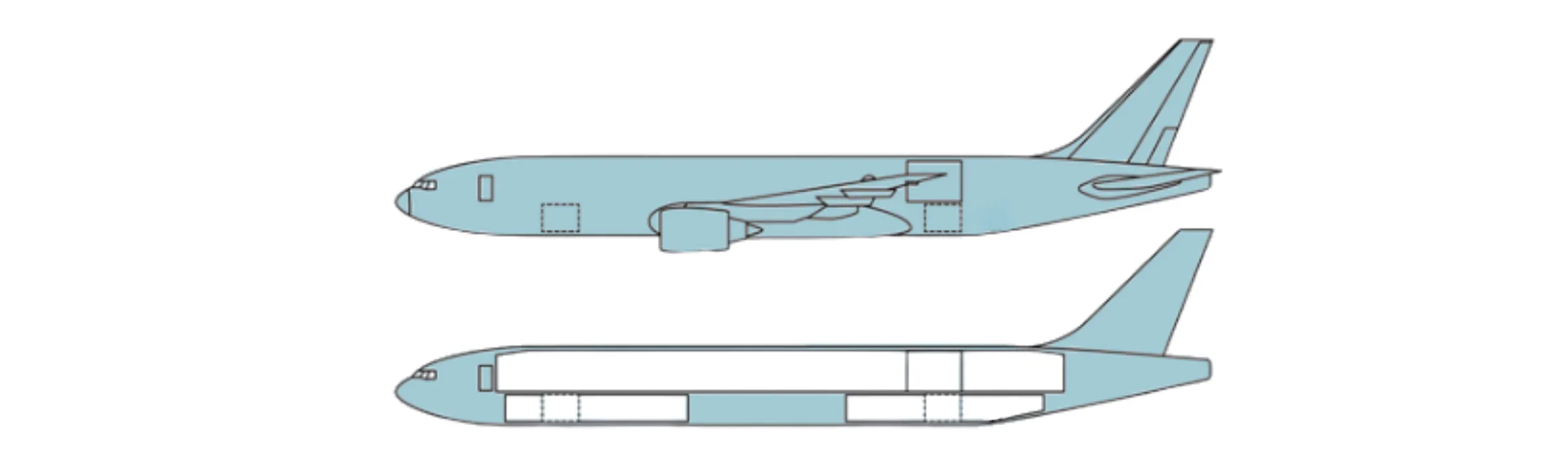
At maximum payload (28 t)
≈ 3,800 km
At maximum payload, the A321F can fly approximately 3,800 km, according to EFW and Airbus. This covers most European routes and many services to North Africa and the Middle East without a stop.
Approximate great-circle distances
As a guide, Paris–Istanbul (approximately 2,210 km) is comfortably within the A321F's range. Paris–Dakar (approximately 4,220 km) exceeds its range at maximum payload. This may require a technical refuelling stop, known as a ‘fuel stop’, or a reduced payload. These are direct distances; the actual flight path is often longer.
Range depends on actual cargo weight, weather, upper-level winds, departure temperature, runway length and mandatory fuel reserves. Published range is indicative: the operator calculates the payload available for each flight.
Before submitting a proposal, we confirm the route-specific payload with the operator, along with any required stops, airport suitability and overflight permits.
A321F aircraft in service are passenger A321s converted into freighters. The A321P2F programme, launched in 2015 by Airbus together with ST Engineering and EFW, is backed by Airbus. The figures below are those published by Airbus and EFW.
| Airbus A321F (A321P2F) | |
|---|---|
| Maximum payload | up to 28 t |
| Cargo volume (containers) | ≈ 208 m³ |
| Main deck | 14 containers, 2.24 × 3.18 m (AAA/AAY) |
| Lower deck | 10 LD3-45W containers + 5.9 m³ bulk compartment |
| Cargo door | side door, 3.61 × 2.16 m |
| Range | ≈ 3,800 km at maximum payload |
| Maximum take-off weight | 93.5 t |
| Engines | 2 × CFM56-5B or IAE V2500, depending on aircraft |
| Length / wingspan | 44.51 m / 35.80 m |
Sources: Airbus, A321P2F; EFW. Indicative figures may vary with aircraft, weight variant and route.

Side cargo door
3.61 × 2.16 m · hydraulic operation
Main deck
14 containers · 2.24 × 3.18 m
Lower deck
10 LD3-45W containers · plus 5.9 m³ bulk cargo
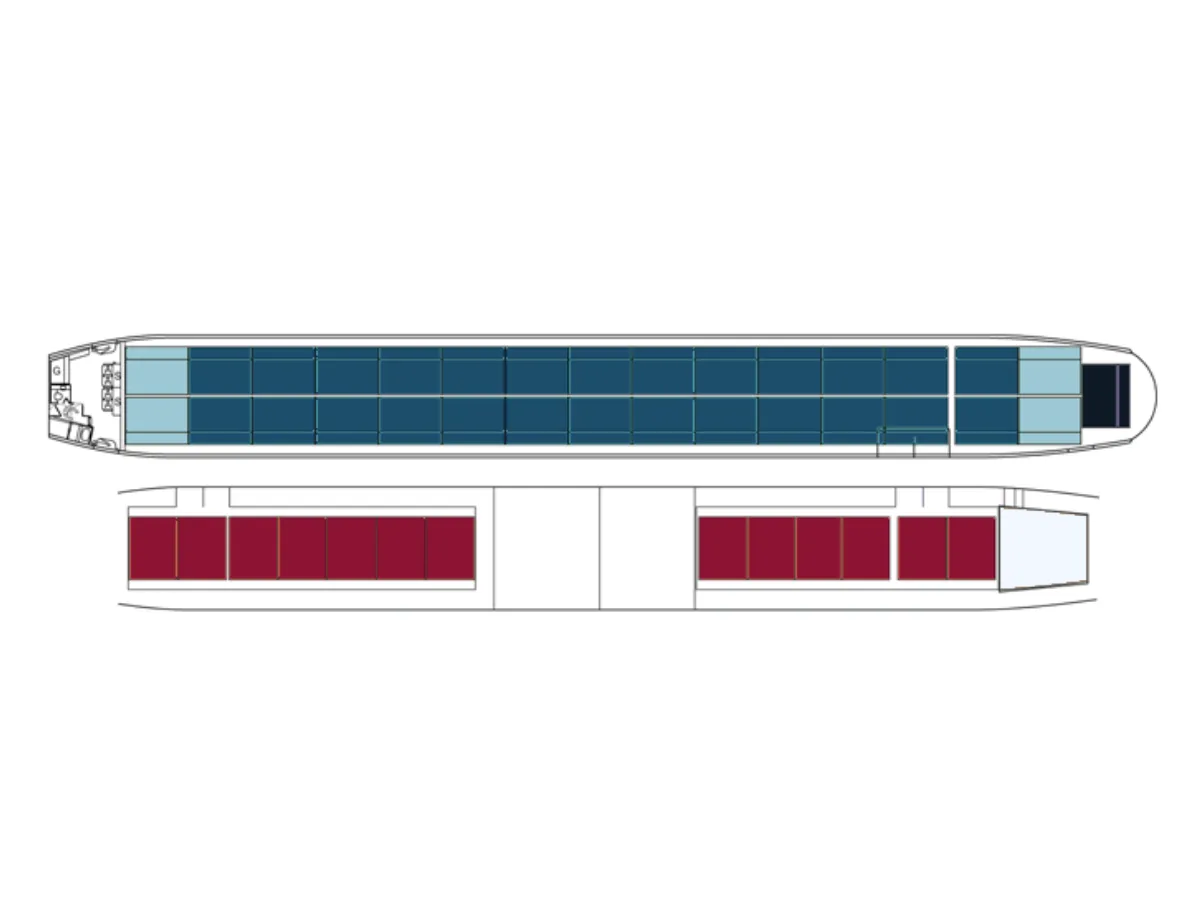
Main deck: 14 container positions measuring 2.24 × 3.18 m (88 × 125 inches), loaded through the forward side cargo door. Lower deck: 10 LD3-45W containers and a 5.9 m³ bulk compartment. Total cargo volume is approximately 208 m³.
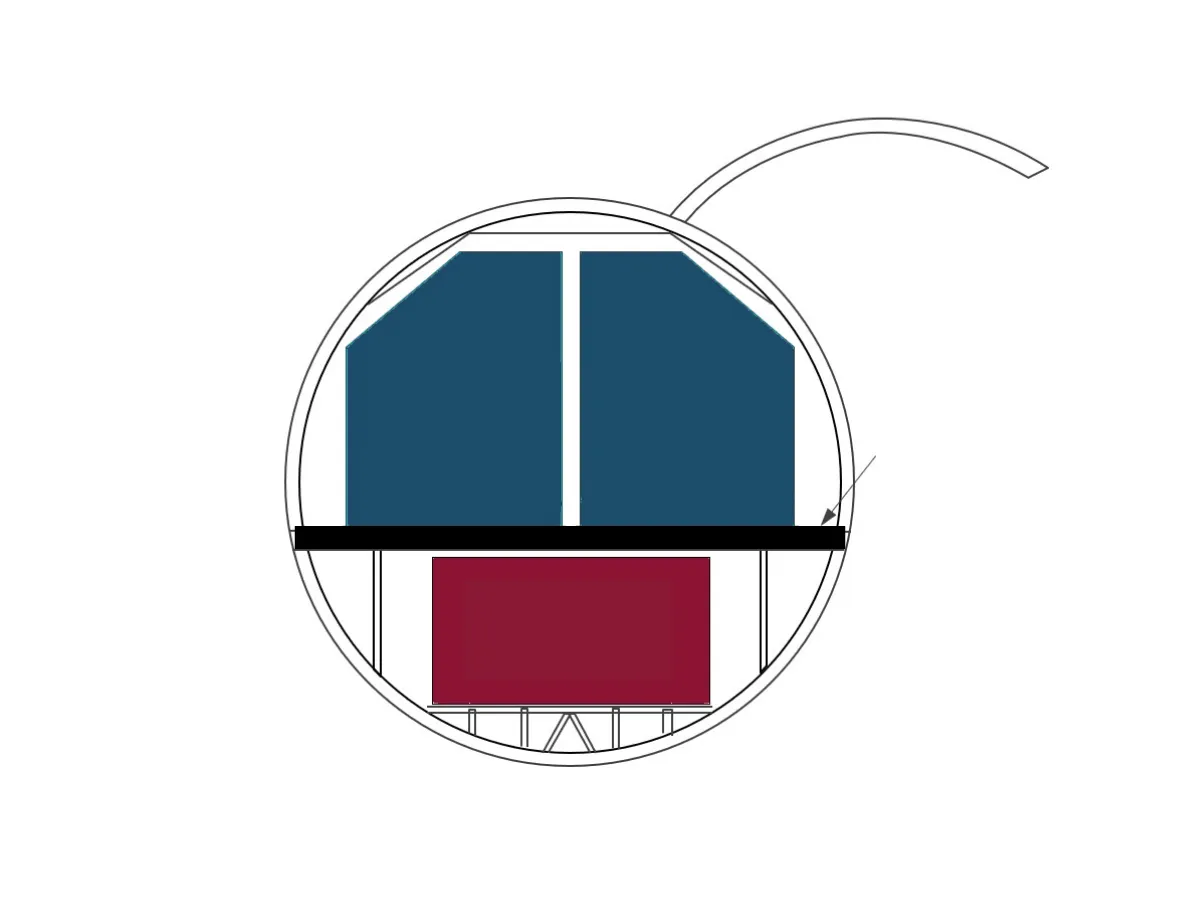
The A321F is a narrow-body aircraft with a smaller fuselage than a wide-body freighter and a maximum cabin width of 3.70 m. Package height is restricted by the 2.16 m cargo door and container contours.
Generic indicative diagrams, not to scale. A321F dimensions are based on Airbus and EFW data; allowable package dimensions depend on the operator's loading charts.
The A321F primarily carries containerised cargo: express and e-commerce parcels, automotive and industrial spare parts, electronics, perishables and pharmaceuticals. Temperature-controlled shipments depend on the operator's equipment and procedures.
On this aircraft, volume is often the first constraint: light freight can fill all 208 m³ well before the 28-tonne payload limit is reached.
Each package must fit inside a container and pass through the 3.61 × 2.16 m side cargo door. Oversized pieces require a different aircraft. We confirm feasibility with the operator using each package's three dimensions and weight.
The operator calculates individual container loads and weight distribution to maintain aircraft balance. Dangerous goods must comply with IATA Dangerous Goods Regulations (DGR) and be declared when requesting a quote (see our dangerous goods missions).
A core application. We verify container numbers and airport slots.
Fast, direct flights. We check package dimensions against container limits.
Short- and medium-haul services. We confirm cold-chain requirements and arrival handling with the operator.
Suitable for medium-sized shipments. We check runway suitability, handling and arrival permits.
Possible with one or more technical stops. We compare wide-body alternatives.
A Boeing 747-400F or Antonov AN-124 may be more appropriate.
We consider the A321F for shipments of 10 to 28 tonnes over short or medium distances, or where the destination airport cannot accommodate a wide-body freighter. Our assessment starts with volume and container numbers, not just total weight.
We identify the proposed aircraft, its weight variant and the payload available on your route. We also verify the operator and its Air Operator Certificate (AOC) in line with our safety commitment.
We review departure and arrival airports, slots, cargo handling, overflight and landing rights, and any temperature-control or security requirements. Aircraft positioning is included from the initial estimate.
For larger shipments or longer routes, we consider an Airbus A330-200F or Boeing 777F. For smaller consignments, part charter may be sufficient.
For a sporting competition held in Iceland, around fifteen European teams needed to ship their equipment, gear and non-motorised vehicles. Rather than organising as many separate shipments, we consolidated all the cargo in Brussels, then chartered an Airbus A321F to Keflavík, Reykjavik's international airport.
The cargo combined equipment from several disciplines (sea, road and mountain) and non-motorised vehicles: a bulky rather than very heavy shipment. With 24 loading positions across two decks, the A321F offered the volume required without paying for wide-body capacity.
Brussels and Keflavík are about 2,150 km apart in a straight line, well within the A321F's range. We sourced an aircraft available on the competition dates and confirmed the payload with the operator.
Each team delivered its equipment to Brussels by truck. With around fifteen shippers, arrivals had to be scheduled precisely so that all the cargo was received on time without congesting the preparation area.
We coordinated this schedule with the freight forwarder and the handling agent, and checked the equipment declared by each team before the pallets were built up.
We supervised the palletisation of the equipment with the client, taking into account the weight and dimensions of each item to comply with the aircraft's loading plan.
As Iceland is not part of the European Union, we prepared the customs declarations with the freight forwarder, checked the flight documents before sending them to the airline and filed the necessary permit requests.
On departure day, we supervised the loading of the aircraft in Brussels with the client, then monitored the flight through to its arrival in Keflavík.
The equipment of every team travelled to Iceland on a single flight, instead of some fifteen shipments to coordinate separately.
This mission shows our role as conductor on a cargo charter: consolidating freight from around fifteen shippers, organising its palletisation, securing documents, customs and permits, then supervising loading through to departure.
Other missions carried out by Artheau Aviation on the Airbus A321F
Our air freight department organises dedicated cargo flights, as a full charter or part charter, in France, Europe and internationally. Our role as a broker: find the right aircraft for your shipment, confirm that the flight is feasible and coordinate everyone involved through to delivery.
We compare available freighters by weight, dimensions and loading doors, working only with AOC-holding airlines selected in line with our safety commitment. We also check the airports: runway, loading equipment, handling and opening hours.
We coordinate overflight and landing permit requests with the operator; requirements vary by country, type of cargo and type of flight.
For dangerous goods, we check with the operator that the shipment can be accepted under the IATA Dangerous Goods Regulations (DGR). We then review all flight documents with you and pass them on to the airline. We make sure they are complete and accurate, as a missing or incorrect document can keep the aircraft on the ground. Classification, packaging, marking and labelling remain the shipper's responsibility; some materials, such as radioactive materials, are subject to additional limitations. On every operation, we act as the conductor between you, the operator and the airports.
We liaise between the operator, the airports, the handling agents and your freight forwarder, with whom we coordinate customs formalities. The flight is tracked in real time with the operator's operations control centre, and you keep a single point of contact throughout.
Provide the number of packages, their dimensions and weight, packaging, cargo type, route and dates. Specify whether temperature control is required or dangerous goods are included.
We check container numbers, cargo door clearance and route-specific payload with the operator. We then present the available options, including full or part charter and another aircraft where appropriate.
Once confirmed, we coordinate every stage with the operator, airports, freight forwarder and ground handlers. We review the flight documents with you before sending them to the airline, and monitor the flight through to delivery.
There is no fixed price. For full charter, the cost covers the entire aircraft and depends on the route, positioning, fuel, airport charges, handling and permits. For part charter, it depends on the space used. We provide a tailored quote for every enquiry.
Up to 28 tonnes, according to Airbus and EFW. Actual payload depends on the aircraft, route and required fuel. Light, bulky cargo may fill the available 208 m³ before reaching this weight.
The aircraft holds 14 containers measuring 2.24 × 3.18 m on the main deck and 10 LD3-45W containers below. This gives 24 positions and approximately 208 m³ of total capacity, including a 5.9 m³ bulk compartment.
The main-deck side cargo door measures 3.61 m wide by 2.16 m high. For taller cargo, we consider a Boeing 777F or Boeing 747-400F.
Approximately 3,800 km according to EFW, covering most European routes and some services to North Africa and the Middle East without a stop. Longer flights may require a technical stop or reduced payload, which we assess when preparing your quote.
Both are similarly sized narrow-body freighters. According to EFW, the A321F offers 13.5% more container capacity and uses approximately 9% less fuel per tonne. For charter enquiries, we compare both aircraft when they are available on the requested route.
Yes. These are core applications: its cargo volume, standard containers and suitability for regional airports make it a common choice for express freight networks in Europe.
Provide origin, destination, cargo readiness date, package count, dimensions, weight, packaging and cargo description. Request your quote or see our air freight FAQ.
From private jet charters to commercial group flights and dedicated cargo operations, we deliver tailored air solutions for every mission, anywhere in the world.