
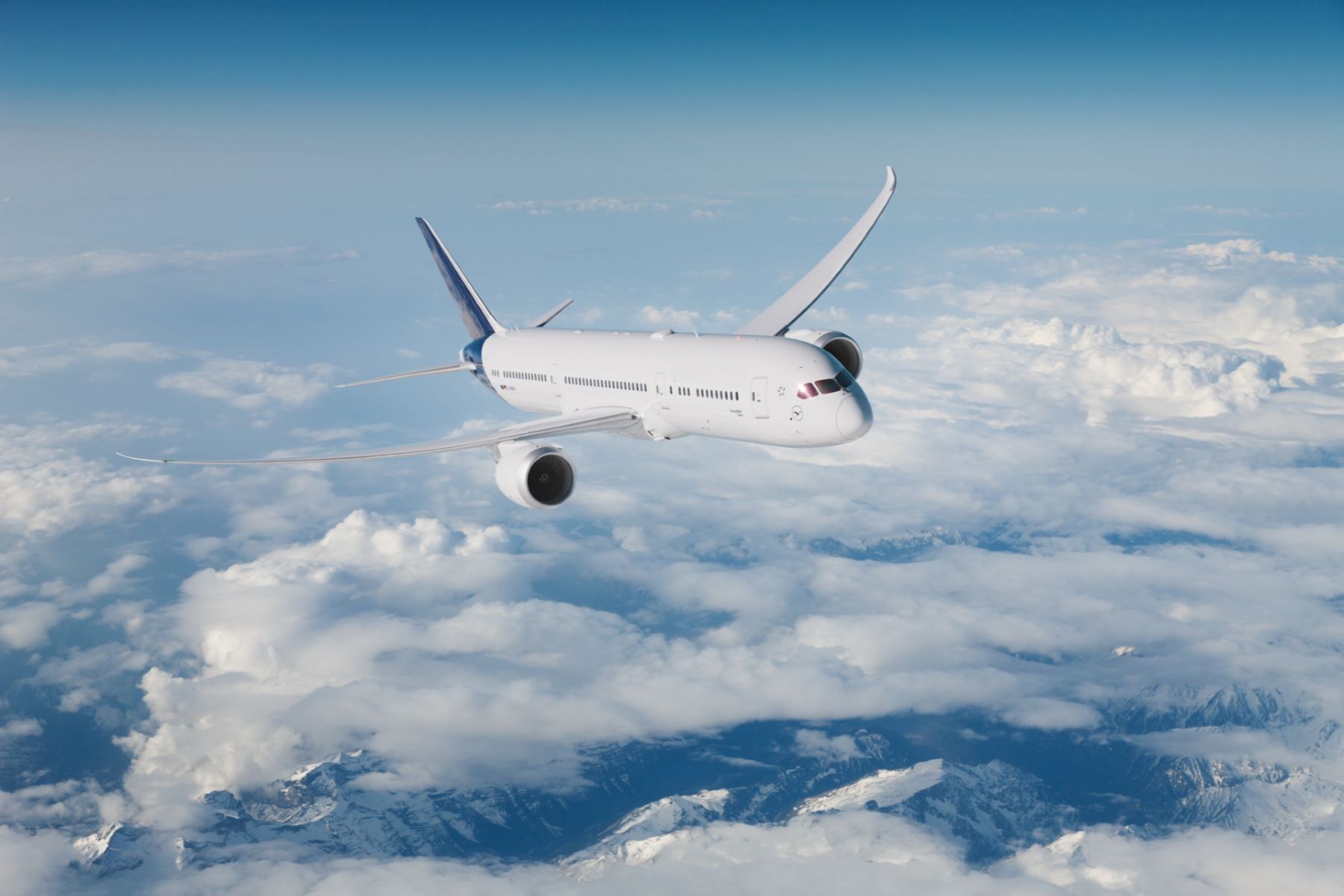

The Airbus A350 is a modern long-haul twin-engine aircraft built largely from composite materials. According to Airbus, the A350-900 accommodates 332 to 352 passengers in three classes. The longer A350-1000 can accommodate 375 to 400 passengers. Depending on the version, its range reaches 15,750 to 16,850 km nonstop.
For charter flights, we consider the A350 for long-haul groups of 250 to 400 passengers. At Artheau Aviation, we check aircraft availability, the actual cabin configuration and the range required for your route.
Passengers
332 to 400
In three classes, depending on the version (-900 or -1000).
Range
15,750 to 16,850 km
Airbus reference values, depending on the version and payload.
Cruise speed
Mach 0.85
Reference cruise speed.
Maximum take-off weight
283 to 324 t
Depending on the version (-900 or -1000).
An A350 is chartered on a quotation basis, with no fixed public price. The budget depends mainly on flight time and the aircraft's location. If the aircraft must fly to your departure airport, this positioning flight is included in the price.
Landing and overflight charges are added to the cost of the flight. Wide-body ground handling and potential crew accommodation also contribute to the final budget.
On long-haul routes, lower fuel consumption compared with four-engine aircraft can provide an advantage. Airbus states around 25% lower fuel consumption compared with previous-generation aircraft. The choice between an A350-900 and A350-1000 mainly depends on passenger numbers and distance.
To obtain a price for your flight, request a quote. We contact operators offering the A350 and, when necessary, compare it with an A340 or A380 on the same dates.
The A350 can transport a large group on a long-haul flight aboard a modern aircraft. Several characteristics make it suitable for this type of charter.
The cabin provides an environment designed to improve passenger comfort during long-haul journeys.
The A350-900 and A350-1000 offer different capacities. We select the version according to passenger numbers and route requirements.
Its range allows flights from Europe to Southeast Asia or South America without a technical stop. Actual feasibility still depends on payload and flight conditions.
Its two modern engines consume less fuel than an A340 or 747-400 of comparable capacity. This difference becomes significant on an intercontinental return flight.
Its main limitation is charter availability. The A350 is mainly operated by scheduled airlines, and not every aircraft is offered for charter. Depending on the dates, an A340 or another aircraft may be easier to source. We then present an alternative suited to your project.
Airbus states a range of 15,750 km for the A350-900 and 16,850 km for the A350-1000. These figures are manufacturer reference values.
Actual range depends on passenger numbers, baggage, winds and temperature. Regulatory fuel reserves also affect the distance available for each flight. The operator therefore validates every route before we propose the aircraft.
From Paris, Bangkok, approximately 9,400 km away, and Buenos Aires, around 11,100 km away, remain within its range. Paris–Perth, approximately 14,300 km, must be assessed according to the version and payload. Paris–Auckland, around 18,500 km, requires a stop.
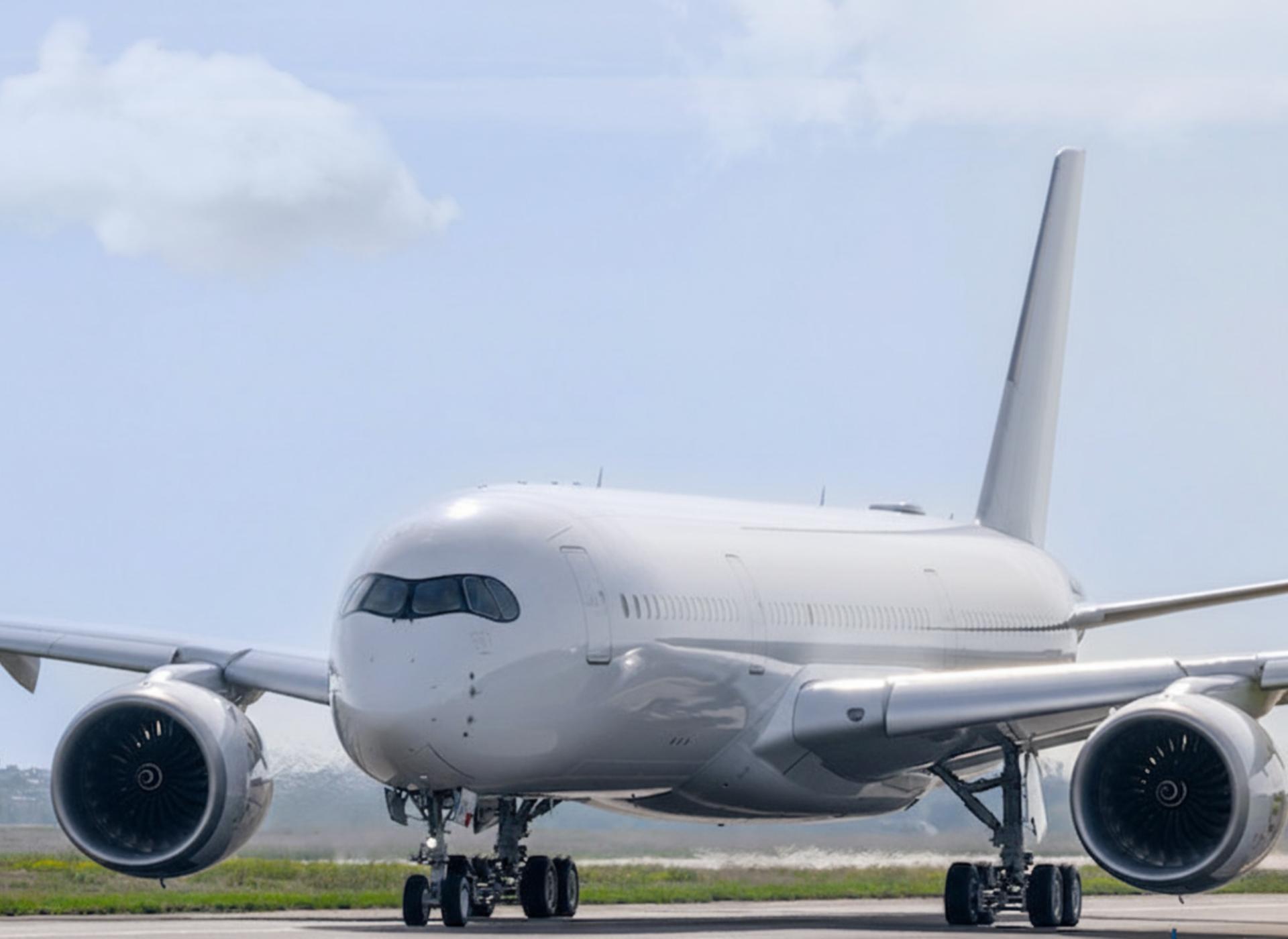
Both versions share a 64.75 m wingspan and the same cabin width. They also use Rolls-Royce Trent XWB engines, with the -84 powering the A350-900 and the -97 powering the A350-1000.
The A350-1000 is approximately seven metres longer than the A350-900. This additional length allows it to accommodate up to around 40 more passengers.
In three classes, Airbus states 332 to 352 seats for the A350-900 and 375 to 400 for the A350-1000. Maximum certified capacity reaches 440 seats on the -900 and 480 on the -1000 in high-density configurations.
For charter flights, capacity depends on the cabin of the aircraft available. Airline-operated A350s often have a large business-class cabin, which reduces the total number of seats. We provide the exact seating distribution by class before confirmation.
The A350-900 can accommodate up to 36 LD3 containers, while the A350-1000 can carry up to 44. This capacity provides significant space for group baggage.
On very long flights, total weight can become more restrictive than available hold space. We therefore confirm the baggage allowance with the operator for each charter.
A350s offered for charter generally retain their operator's cabin, with two or three classes depending on the aircraft. Some configurations also include a premium economy cabin.
We provide the cabin plan of the proposed aircraft so you can organise your group. A delegation can, for example, travel in business class while the rest of the group uses economy.
| Charter mission | A350 suitability | Our analysis |
|---|---|---|
| Group of 250 to 400 passengers on a long-haul flight | Suitable | We select the -900 or -1000 according to group size. Nonstop feasibility is confirmed for each route. |
| Intercontinental sports team tour or travel | Suitable | The cabin is suitable for long flights. Equipment travels in the hold within the permitted weight limits (sports charter). |
| Incentive trip or conference on another continent | Suitable | The A350 is suitable when the available cabin provides the level of service expected by the group (our group charter missions). |
| Very long-haul flight beyond 14,000 km | To be assessed | Feasibility depends on the version and payload. The operator may limit payload or require a stop. |
| Group of more than 400 passengers | Limited suitability | An A380 or Boeing 747-400 provides greater seating capacity. |
| Medium-haul flight or group of fewer than 220 passengers | Generally oversized | An A321 can reduce the charter cost for this type of requirement. |
| Cargo-only operation | Not suitable | A freighter such as the A330-200F or Boeing 777F is designed for this type of operation. |

We consider the A350 when several hundred passengers need to travel together on an intercontinental flight. On these routes, flight duration also makes cabin configuration and passenger comfort important factors.

We check the proposed version, A350-900 or A350-1000, together with the cabin plan and number of seats in each class. We also check the baggage allowance by weight and the operator's certifications.

An A350 requires a parking stand and ground handling services suitable for wide-body aircraft. On very long flights, we also check operational requirements related to crew duty times.

The A340 offers similar capacity and may be available when no A350 matches the required dates. Above 400 passengers, we generally consider an A380 or Boeing 747-400.
For a smaller group, a long-range A321 may provide a more suitable solution.
Provide the dates, airports, passenger numbers and preferred cabin-class distribution. These details help determine whether an A350-900 is sufficient or an A350-1000 is required.
We identify A350s offered by operators and check their cabins and route feasibility. We then present the available options, including suitable alternatives.
Once the charter is confirmed, we organise each stage with the operator and airports until the return flight.
We do more than find an available aircraft. From your first request to landing, our teams coordinate every stage of your charter.
Your dedicated broker remains your main point of contact throughout your journey, from the initial request to your arrival.
We compare aircraft and certified operators to recommend the solution best suited to your itinerary, requirements and budget.
Once your flight is confirmed, our Flight Preparation team coordinates the operational details required for a smooth journey.
The team oversees flight logistics, ground handling, catering, passenger requirements and other arrangements before departure.
Every flight is operated by a certified aircraft operator holding the licences and approvals required for the mission.
We review operators, aircraft and operational requirements to check that each proposed solution meets our safety and compliance standards.
There is no fixed price. The cost depends on flight time, aircraft positioning and airport charges. Ground handling and potential crew accommodation also affect the budget. We prepare a quote after consulting operators for your dates.
The A350-900 is generally suitable for up to around 350 passengers. The A350-1000 can accommodate up to 400 passengers in three classes. The available aircraft's cabin and the flight distance also influence the choice.
Maximum take-off weight is 283 tonnes for the A350-900 and 324 tonnes for the A350-1000. For charter operations, this limit includes fuel, passengers and baggage. We therefore check the available payload before each long-haul flight.
Airbus states 332 to 400 passengers in three classes, depending on the version. Capacity can be lower when the cabin includes more business-class seating. We provide the exact number of seats on the proposed aircraft before signing.
Yes, in many cases. Paris–Bangkok and Paris–Buenos Aires are within its operating range. Beyond approximately 14,000 km, feasibility depends more heavily on the version, payload and flight conditions.
Both aircraft can carry groups of a similar size. The A350 is a newer twin-engine aircraft and consumes less fuel. However, an A340 may be easier to source on certain dates. We compare both aircraft when available.
Yes. The A350 can carry a team, staff, partners or supporters on a long-haul flight. We check the available baggage capacity and requirements for sports equipment with the operator.
From private jet charters to commercial group flights and dedicated cargo operations, we deliver tailored air solutions for every mission, anywhere in the world.


