The Airbus A380 is the only passenger aircraft with two full-length decks and stands apart for its exceptional capacity. It typically accommodates 545 to 555 passengers in Airbus reference configurations, with a maximum capacity of 853 in an all-economy layout. With a typical cabin configuration, its range reaches approximately 15,000 km nonstop.
For charter operations, the A380 serves a specific purpose: transporting a very large group together on a single long-haul flight. Since production ended in 2021, the aircraft has primarily been operated on scheduled services by airlines including Emirates, Lufthansa and Singapore Airlines.
A380 charter availability is therefore limited, but remains possible depending on your dates, aircraft availability and the airports involved. At Artheau Aviation, we assess these factors before determining whether the A380 is a suitable solution for your project.
Passengers
545 to 555
In typical cabin configurations; up to 853 passengers in an all-economy layout.
Range
15,000 km
With 545 passengers, depending on payload and operating conditions.
Cruise speed
Mach 0.85
Long-haul cruise speed stated by the manufacturer.
Baggage hold
Approximately 175 m³
Lower-deck cargo volume, divided between containers and bulk-loading areas.
There is no fixed price for chartering an Airbus A380, as every operation requires a specific quotation. Aircraft positioning often represents a significant cost, particularly when the A380 must fly to your departure airport before the charter begins.
This factor is particularly important for the A380 because very few aircraft are currently available on the charter market. Depending on its initial location, positioning flights to your departure airport and back to its operating base can therefore be substantial.
Landing and parking charges depend partly on the aircraft’s weight and the airport infrastructure required for the operation. Ground handling, overflight permits, catering and potential crew accommodation costs must also be considered.
The cost per passenger therefore depends significantly on the load factor and the cabin configuration used for your operation. An A380 operating at three-quarters capacity does not offer the same cost per seat as a fully occupied aircraft.
For an initial estimate, you can use our airliner charter price calculator. For an accurate quotation, we contact operators with potential A380 availability and compare this solution with other suitable wide-body aircraft.
The A380 becomes relevant when the size of your group and the need to travel together are the primary requirements of your project.
Keeping all passengers on the same aircraft simplifies the coordination of schedules, boarding and transfers at the destination. A two-aircraft solution requires the coordination of two flights, two crews and multiple ground operations.
The main and upper decks allow passengers to be divided between separate areas, depending on the available cabin configuration. This arrangement can help separate an official delegation, invited guests or staff from the rest of the group.
The lower-deck hold can accommodate passenger baggage alongside equipment required for tours, sporting events or other large-scale projects. Sports equipment and additional materials remain subject to available space and the aircraft’s weight limitations.
Major long-haul airports have infrastructure designed to handle Airbus A380 operations and several hundred passengers simultaneously. Some airports also provide boarding bridges serving both decks to facilitate passenger boarding and disembarkation.
The main limitation remains availability, as very few A380s are offered on the charter market. The aircraft must also operate through airports with infrastructure suitable for its dimensions and weight.
For smaller groups, a Boeing 747-400, an Airbus A350 or multiple lower-capacity aircraft may provide more accessible alternatives.
According to Airbus, the A380 can fly approximately 15,000 km nonstop with 545 passengers in a four-class configuration. This figure is a reference value and necessarily varies according to the actual conditions of each operation.
Payload, upper-level winds, departure temperature and regulatory fuel reserves all influence the distance achievable on a specific flight. At Artheau Aviation, we therefore have every proposed route validated by the operator before presenting the aircraft.
From Paris Charles de Gaulle, Singapore is approximately 10,700 km away, while Los Angeles is approximately 9,100 km away. Both destinations therefore remain within the A380’s theoretical operating range, depending on flight conditions.
Paris to Sydney, however, covers approximately 16,900 km and exceeds the manufacturer’s stated reference range. A technical stop would therefore be required, for example in Dubai, followed by a second sector of approximately 12,000 km.
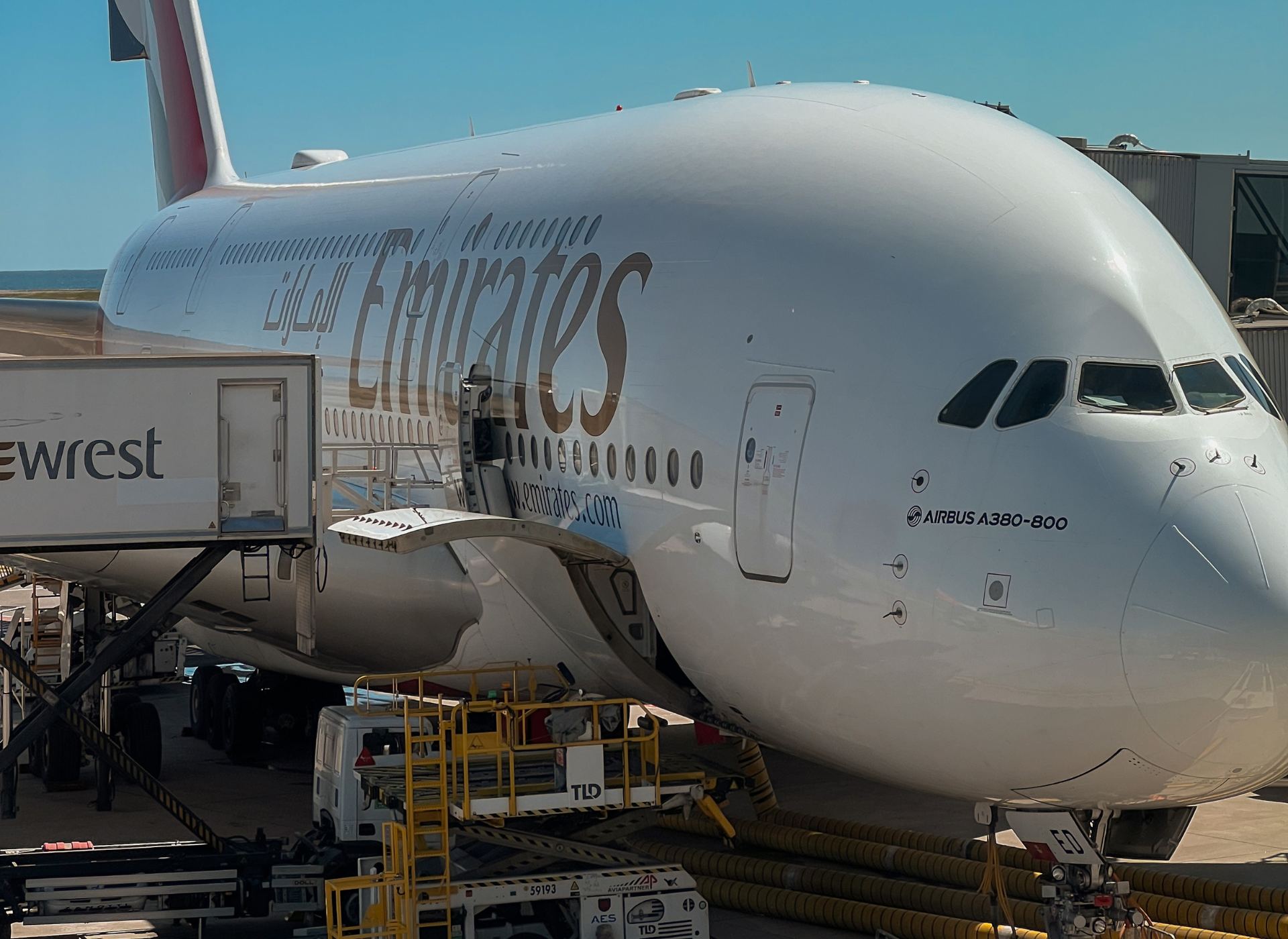
Airbus delivered 251 A380-800 aircraft between 2007 and December 2021, when production of the programme ended. Aircraft currently in service differ mainly in engine type, maximum take-off weight and cabin configuration.
| Specification | Airbus A380-800 |
|---|---|
| Length | 72.7 m |
| Wingspan | 79.8 m |
| Height | 24.1 m |
| Maximum cabin width | 6.5 m on the main deck; 5.8 m on the upper deck |
| Passenger deck floor area | 550 m² |
| Maximum take-off weight | 560 or 575 tonnes depending on variant |
| Fuel capacity | Approximately 320,000 litres |
| Engines | 4 × Rolls-Royce Trent 900 or 4 × Engine Alliance GP7200 |
| Cruise speed | Mach 0.85 |
Sources: Airbus, A380 Facts and Figures, February 2022, and Aircraft Characteristics – Airport and Maintenance Planning A380. Manufacturer data.
In the standard configuration described by Airbus, the A380 accommodates 555 passengers across its two passenger decks. The main deck accommodates 356 passengers, while the upper deck accommodates 199 passengers in this reference configuration.
Airbus also provides a four-class reference configuration with 545 seats and a maximum certified capacity of 853 passengers. This maximum capacity corresponds to an aircraft configured entirely with economy-class seating.
These figures remain theoretical for charter operations because A380 aircraft currently in service feature significantly different airline cabin layouts. Some airlines prioritise premium cabins, while others operate denser configurations with a higher overall seating capacity.
Actual charter capacity therefore depends on the specific aircraft and cabin layout available at the time of your request. We provide this configuration before confirmation to ensure that it meets the requirements of your group.
The lower-deck hold provides approximately 175 m³ of cargo volume, divided between containers and bulk-loading areas. With several hundred passengers, however, available capacity must be assessed carefully according to baggage volume and weight.
We therefore confirm the baggage allowance per passenger and the remaining capacity for additional equipment directly with the operator. This assessment is completed before confirmation so that loading requirements can be incorporated into the operation from the outset.
In most cases, the aircraft retains the cabin configuration used by the airline that normally operates it. Its different travel classes, entertainment systems and specific upper-deck areas therefore generally remain in their existing configuration.
We provide the cabin plan, available seat count and distribution of passengers between the two decks before confirmation. This allows you to organise different passenger groups and seating arrangements according to the requirements of your project.
| Charter mission | A380 suitability | Our analysis |
|---|---|---|
| Group of more than 400 passengers on a long-haul flight | Suitable | The A380 can transport the entire group on one flight instead of using two wide-body aircraft, subject to availability. |
| Official delegation or group requiring different service levels | Suitable | The two decks can help separate guests, staff and other passengers according to the available cabin configuration. |
| Pilgrimage or seasonal mass transportation | To be assessed | The A380 has previously been used for these operations, but aircraft availability and airport slots may be limited during peak periods. |
| Tour, event or supporter group travelling with equipment | To be assessed | The aircraft offers significant baggage capacity, but passenger allowances and total payload must be confirmed with the operator. |
| Group of 250 to 350 passengers | Generally oversized | For this group size, an Airbus A340 or another wide-body aircraft may generally provide a solution better suited to the requirement. |
| Medium-haul flight or regional airport | Limited suitability | Runway, parking and boarding infrastructure requirements often make the A380 unsuitable for operations through regional airports. |
| Cargo-only operation | Not suitable | The A380 is a passenger aircraft. A Boeing 747F or Antonov AN-124 is better suited to dedicated cargo operations. |

We consider the A380 when several hundred passengers need to travel together and reach their destination at the same time. This solution can be particularly relevant when the group requires a shared arrival process and a common programme immediately after landing.
We first confirm whether an aircraft is genuinely available for the requested dates before conducting a more detailed operational assessment. We then compare the A380 with a two-aircraft solution to evaluate the differences in cost and organisation.

We analyse the aircraft’s location, positioning requirements and precise cabin configuration before making any recommendation. We also assess runway, taxiway and parking compatibility, together with the infrastructure required to handle the upper deck.
Ground handling providers must be capable of processing several hundred passengers, their baggage and the associated departure operations efficiently. We also verify the operator’s licences and consolidate the total operating costs before presenting our proposal.

At major hubs, landing slots and parking stands capable of accommodating an A380 may require significant advance planning. Check-in, security procedures and boarding for several hundred passengers must also be coordinated with the airport and relevant service providers.
On longer rotations, regulatory crew duty and rest requirements can also influence the structure of the operation. Depending on the planned schedule, these constraints may require the aircraft to remain at the destination or necessitate adjustments to the flight programme.

If no A380 is available or the group consists of fewer than 400 passengers, we assess alternative solutions. The Boeing 747-400 may suit certain projects requiring significant passenger capacity on a long-haul route.
For approximately 300 to 350 passengers, an Airbus A350 may provide more appropriate capacity depending on the available configuration. The Airbus A340 can also be considered when baggage requirements or the organisation of the flight make it relevant.
Finally, using two aircraft may provide a more suitable solution when availability, schedules or airport constraints limit the feasibility of an A380 operation.
Provide the exact number of passengers, departure and arrival airports, travel dates and estimated baggage volume. You should also specify any preferred distribution between travel classes and requirements concerning the organisation of your group.
For an Airbus A380, some flexibility around your travel dates can increase the possibility of securing an available aircraft. We consider this factor from the beginning of our search to identify solutions that are genuinely feasible.
We contact operators that may be able to provide an A380 and confirm that the relevant airports can accommodate the aircraft. When an A380 is available, we can compare it with one or more alternative wide-body aircraft suitable for your project.
Our proposal includes the aircraft configuration and cabin plan to help you evaluate the available options. You therefore have the information required to compare each solution before making your decision.
Once the charter is confirmed, we coordinate the different stages of your flight with the operator and relevant airports. This includes airport slots, ground handling and the organisation of your group’s boarding process.
Your Artheau Aviation air charter broker remains your point of contact throughout the preparation and operation of your flights, including the return journey.
We do more than find an available aircraft. From your first request to landing, our teams coordinate every stage of your charter.
Your dedicated broker remains your main point of contact throughout your journey, from the initial request to your arrival.
We compare aircraft and certified operators to recommend the solution best suited to your itinerary, requirements and budget.
Once your flight is confirmed, our Flight Preparation team coordinates the operational details required for a smooth journey.
The team oversees flight logistics, ground handling, catering, passenger requirements and other arrangements before departure.
Every flight is operated by a certified aircraft operator holding the licences and approvals required for the mission.
We review operators, aircraft and operational requirements to check that each proposed solution meets our safety and compliance standards.
The Airbus A380 cruises at Mach 0.85, equivalent to approximately 900 km/h at its cruising altitude. Its actual ground speed varies depending on the winds encountered during the flight.
A tailwind can increase ground speed, while a headwind can reduce it.
Airbus describes a standard configuration with 555 seats across two decks and a four-class configuration accommodating 545 passengers. The maximum certified capacity reaches 853 passengers when the aircraft is configured entirely with economy-class seating.
For charter operations, capacity always depends on the cabin layout of the specific aircraft available for your project. We therefore provide the cabin plan and confirmed seating capacity before you proceed.
The Airbus A380 measures 72.7 metres in length, 79.8 metres in wingspan and 24.1 metres in height. Its cabin reaches 6.5 metres in width on the main deck and 5.8 metres on the upper deck.
Together, the two passenger decks provide approximately 550 m² of floor area.
The A380 has a maximum take-off weight of 560 or 575 tonnes depending on the aircraft variant. Its maximum landing weight reaches 386 or 394 tonnes, depending on the version concerned.
Its fuel tanks can hold approximately 320,000 litres, representing a significant proportion of the aircraft’s total take-off weight.
According to Airbus, the A380 has a range of approximately 15,000 km nonstop with 545 passengers on board. This figure is a manufacturer reference and does not automatically represent the achievable range for every operation.
Payload, winds, temperature and regulatory fuel reserves all influence the range available for a specific flight. We therefore have each proposed route confirmed by the operator before recommending the aircraft.
There is no fixed price for chartering an Airbus A380 because every operation requires an individual assessment. The final cost depends on factors including aircraft positioning, flight duration, airport charges and ground handling requirements.
Crew costs, catering and potential stopovers can also influence the total charter price. Our calculator provides an initial estimate before we prepare a quotation based on your specific project.
No. The A380 requires runways, taxiways and parking stands compatible with its dimensions and operating weight. Some airports also provide specific infrastructure allowing passengers to board and disembark directly from both decks.
Airbus identifies more than 400 airports worldwide as compatible with A380 operations. We nevertheless verify the specific operating conditions at each airport before recommending the aircraft for your flight.
No. Airbus delivered the final A380 in December 2021 after producing a total of 251 aircraft. The manufacturer nevertheless continues to support aircraft currently operated by airlines.
The A380 remains in scheduled service with airlines including Emirates, Lufthansa and Singapore Airlines. Chartering one remains possible, although aircraft availability depends heavily on your dates and the operators’ existing flight programmes.
From private jet charters to commercial group flights and dedicated cargo operations, we deliver tailored air solutions for every mission, anywhere in the world.