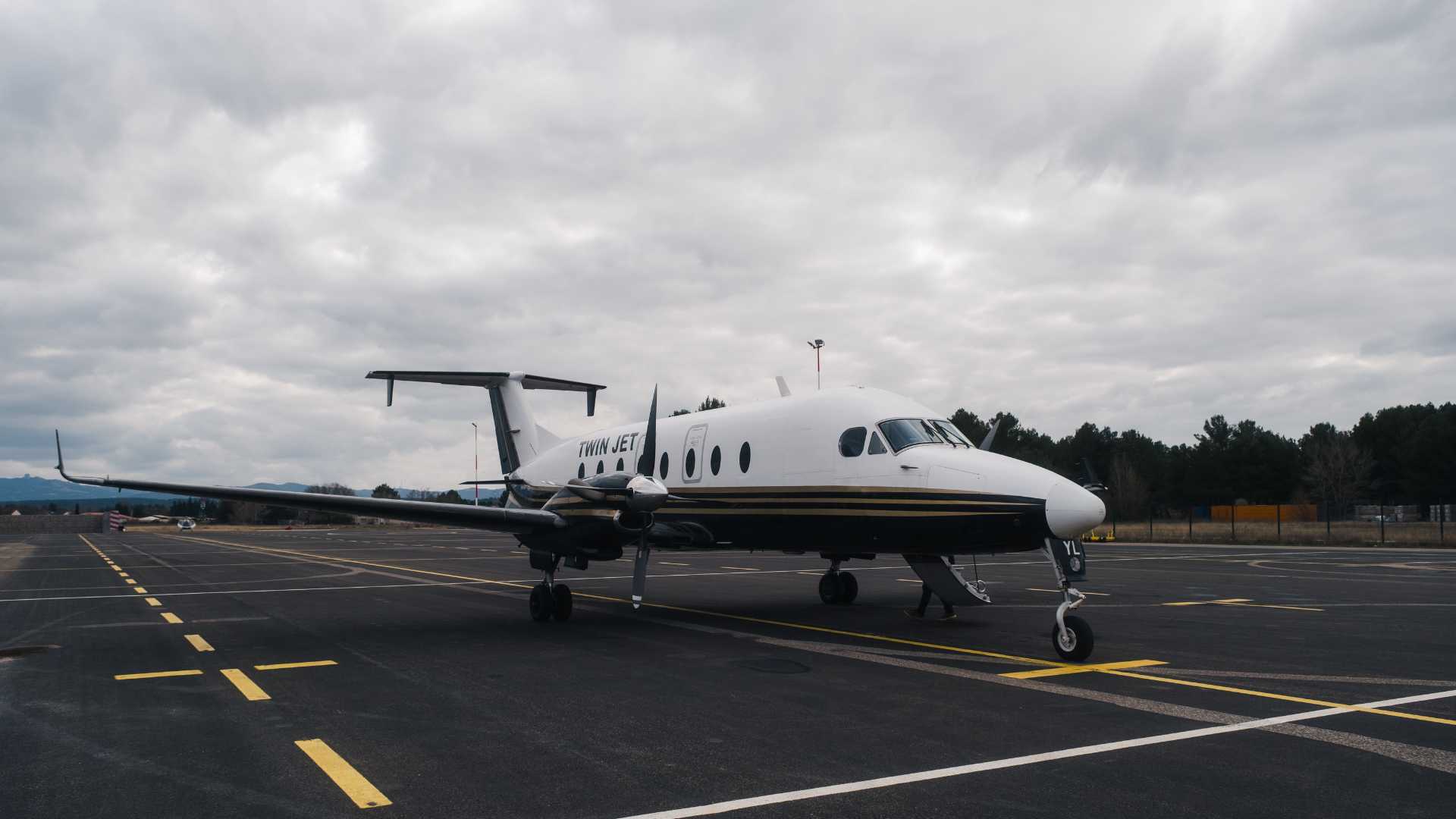

The Beechcraft 1900D is a 19-seat regional twin-turboprop, certified in 1991 and now supported by Textron Aviation. Its 1.83 m cabin allows passengers to stand upright, which is unusual for an aircraft of this size. It cruises at around 520 km/h and covers regional routes of approximately 1,500 km.
For charter flights, we consider it for groups of 10 to 19 passengers travelling on regional routes across France and Europe. It can serve many secondary airports. At Artheau Aviation, we check the proposed aircraft, baggage allowance and route feasibility before recommending it.
Passengers
19
Maximum certified capacity, plus 2 pilots.
Cruise speed
≈ 518 km/h
Around 280 knots, depending on the operator.
Range
≈ 1,500 km
Depending on payload and flight conditions.
Cabin height
1.83 m
Passengers can stand upright.
A Beechcraft 1900D is chartered on a quotation basis. The price depends on flight time, aircraft positioning, airport charges and ground handling.
For a seminar or a same-day return flight, keeping the aircraft and crew at the destination can be more practical. This arrangement can avoid two positioning flights between the aircraft's base and your airport.
On a regional route, a 19-seat turboprop generally costs less than a larger regional jet. This solution remains relevant when the flight time is reasonable. For longer routes, we compare it with faster aircraft.
To find out the price of your flight, request a quote. We contact operators flying the 1900D and present the options available on your required dates.
The 1900D meets a specific need: transporting a small group on a regional route without chartering an oversized aircraft.
With 19 seats, it suits a management team, small sports team or delegation. It avoids chartering a 50-seat aircraft for a smaller group.
Its 1.83 m cabin height makes boarding and moving around easier. It provides more comfort than many smaller turboprop cabins.
Its take-off and landing performance allows it to use many secondary airports. These airports can bring your group closer to its final destination.
Several European operators fly the Beechcraft 1900D, including French airlines. This can reduce positioning distances and associated costs.
Its main limitation is typical of a small turboprop: it is slower than a jet and offers limited baggage capacity. For longer flights or groups carrying substantial equipment, we can propose a faster or larger aircraft.
French operator Chalair states a range of approximately 1,550 km for its Beechcraft 1900D. This distance varies according to passenger numbers, baggage and regulatory fuel reserves.
Wind and weather conditions also affect turboprop performance. The operator therefore validates each route before we propose the aircraft.
Routes such as Nantes–Lyon, around 540 km, Paris-Orly–Milan-Linate, around 640 km, or Bordeaux–Ajaccio, around 830 km, suit its regional role. Paris–Lisbon, approximately 1,440 km, approaches its range limit and requires a case-by-case assessment or a stop.
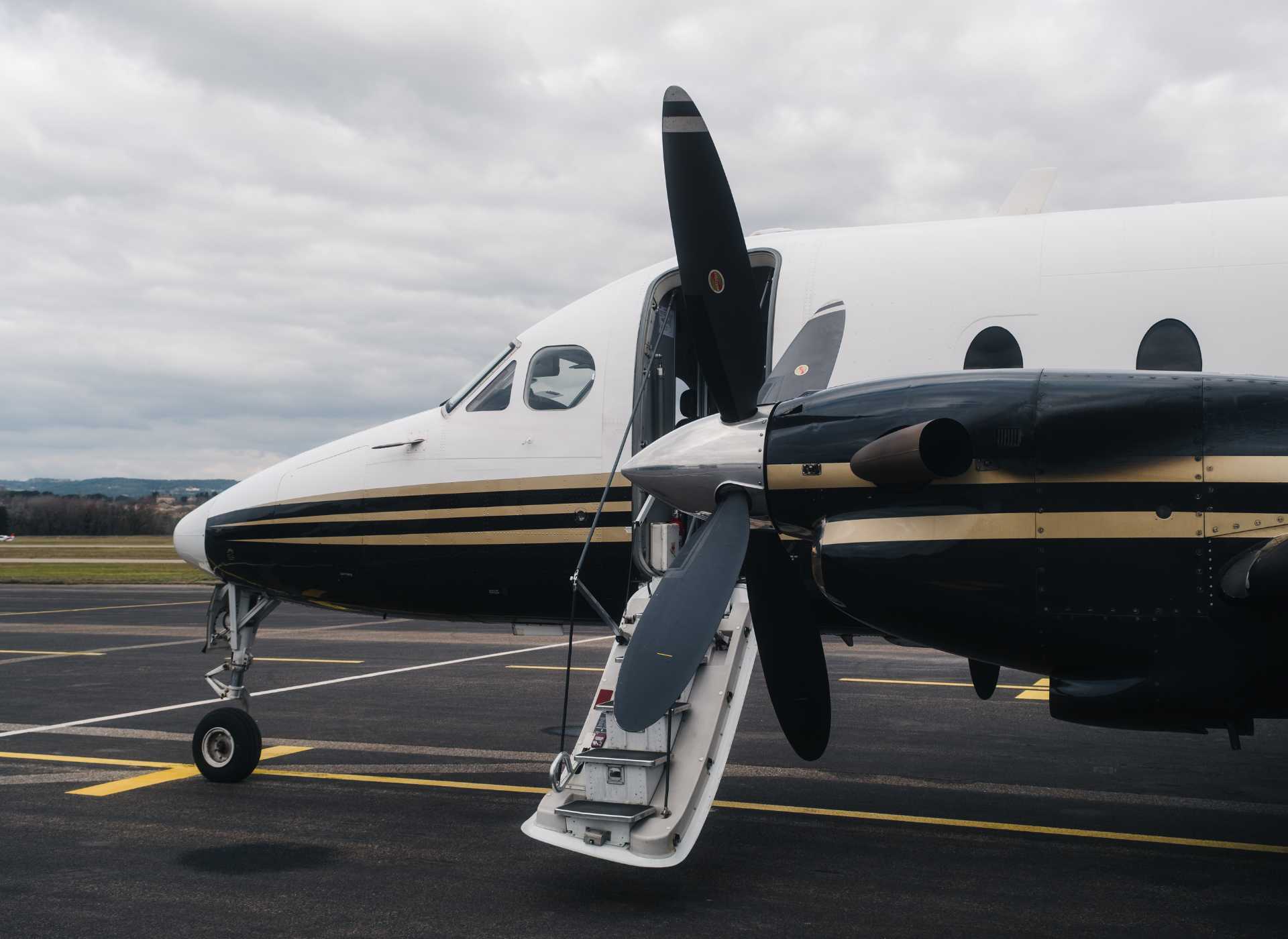
The 1900D is the final version of the Beechcraft 1900, following the 1900C. It is certified in the commuter category for up to 19 passengers. Two Pratt & Whitney Canada PT6A-67D turboprop engines power the aircraft.
| Specification | Value |
|---|---|
| Passengers | 19 (+ 2 pilots) |
| Maximum take-off weight | 7,765 kg |
| Engines | 2 × Pratt & Whitney Canada PT6A-67D |
| Cruise speed | ≈ 518 km/h (280 kt) |
| Service ceiling | 7,620 m (25,000 ft) |
| Take-off distance | ≈ 1,220 m at maximum take-off weight |
| Landing distance | ≈ 910 m |
| Length / wingspan / height | 17.63 m / 17.64 m / 4.72 m |
Sources: New Zealand CAA, Beech 1900C/1900D Type Acceptance Report; Chalair for performance and dimensions. Figures are indicative and may vary by aircraft.
The Beechcraft 1900D is certified for 19 passengers and two pilots. Seats are arranged on either side of a central aisle. Each passenger therefore has a window and direct access to the aisle. The cabin is 1.83 m high, allowing passengers to stand upright.
With 19 seats, the aircraft generally operates without cabin crew. Onboard service is therefore simple and depends on the operator. Before confirmation, we specify the services provided, including drinks or snacks.
In France, the Beechcraft 1900D is operated by Twin Jet and Chalair, among others.
Baggage capacity remains limited compared with larger regional aircraft. For groups carrying sports or technical equipment, we confirm the exact baggage allowance with the operator.
Most Beechcraft 1900Ds available for charter retain a standard 19-seat airline configuration. Some aircraft may have a different layout depending on their operation.
We provide the exact configuration of the proposed aircraft before confirming your charter.
| Charter mission | 1900D suitability | Our analysis |
|---|---|---|
| Seminar or management team of 10 to 19 passengers in France or Europe | Suitable | One aircraft carries the entire group, with the possibility of completing a return flight on the same day (our group charter missions). |
| Small sports team or technical staff | Suitable | The 1900D suits a small group. Available space for equipment must be confirmed with the operator (sports charter). |
| Regular shuttle to an industrial site or secondary airport | Suitable | Its runway performance allows it to serve many regional airports. |
| Flight of more than 1,200 km | To be assessed | The route approaches its operational range. A faster aircraft may also significantly reduce flight time. |
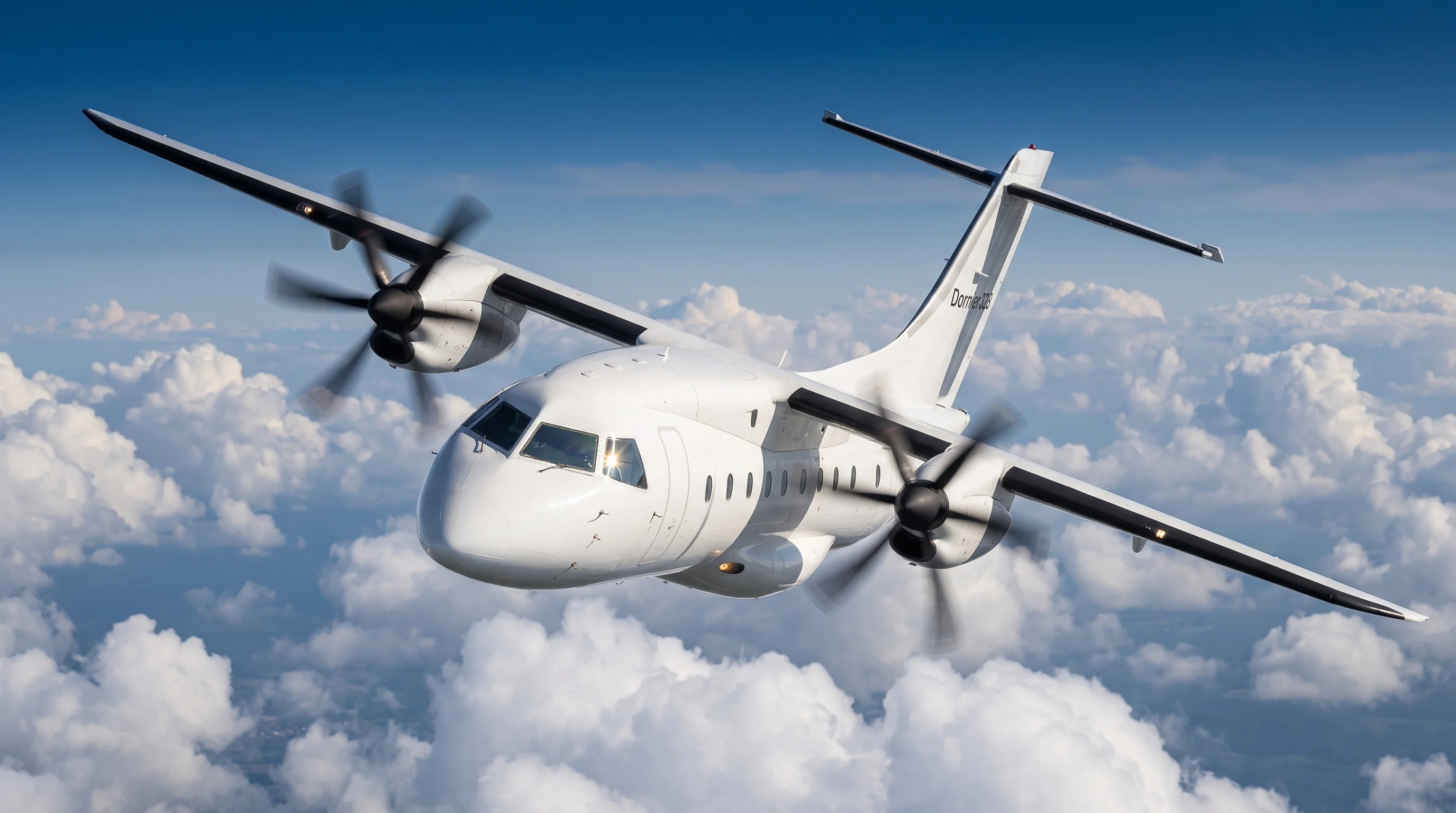
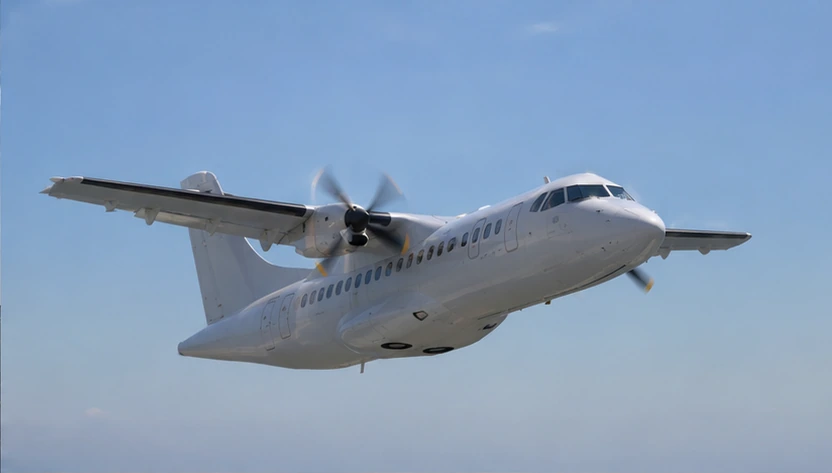
| Group of 20 to 50 passengers | Limited suitability | A Dornier 328, Saab 340 or ATR 42 provides more suitable capacity. |
| Fewer than 9 passengers looking for business-class comfort | Generally oversized | A Pilatus PC-12 or Cessna Citation XLS is better suited to this requirement. |
| Bulky cargo | Not suitable | Hold capacity is limited. We recommend a solution specifically suited to cargo charter operations. |

We consider the Beechcraft 1900D for groups of 10 to 19 passengers travelling on regional routes. Its capacity allows the entire group to travel together without chartering a larger aircraft.

We check the operator, its certifications, the proposed aircraft and its configuration. We also confirm the baggage allowance by volume and weight, together with the services provided onboard.

On longer routes, available payload may be limited. We also check regional airport opening hours and the weather conditions expected for the flight.

Above 19 passengers, we compare the 1900D with the Dornier 328 or ATR 42. For longer routes, a regional jet such as the Embraer ERJ 135 reduces flight time.
For a smaller group, a Pilatus PC-12 may be sufficient.
For a company, we set up a weekly air shuttle between Paris and its production site in Poland, for 15 months across 2025 and 2026.
Allow employees to rotate every week between the headquarters and the production site, on a regular and reliable programme.
A Beechcraft 1900D, suited to the team size and the distance, on a flight programme planned in advance with the operator.
Extensive flight preparation, catering adapted to the teams, ground transfers between the airport and the production site, and the administrative formalities.
For 15 months, every rotation followed the same schedule, with one main point of contact for the whole programme.
This example shows that a charter can also meet a recurring need, not just a one-off flight.
Provide your dates, airports, passenger numbers and expected baggage. This information helps us determine whether the 1900D is suitable for your charter.
We contact 1900D operators and check the aircraft, airports and route feasibility. We then present the available options.
Once the charter is confirmed, we organise each stage of the flight with the operator and airports until the group's return.
We do more than find an available aircraft. From your first request to landing, our teams coordinate every stage of your charter.
Your dedicated broker remains your main point of contact throughout your journey, from the initial request to your arrival.
We compare aircraft and certified operators to recommend the solution best suited to your itinerary, requirements and budget.
Once your flight is confirmed, our Flight Preparation team coordinates the operational details required for a smooth journey.
The team oversees flight logistics, ground handling, catering, passenger requirements and other arrangements before departure.
Every flight is operated by a certified aircraft operator holding the licences and approvals required for the mission.
We review operators, aircraft and operational requirements to check that each proposed solution meets our safety and compliance standards.
There is no fixed price. The cost depends on flight time, aircraft positioning, airport charges and any time the aircraft remains at the destination. We prepare a quote after consulting operators for your dates.
The Beechcraft 1900D can carry up to 19 passengers, in addition to two pilots. For a larger group, we can propose a Dornier 328, an ATR 42 or two aircraft.
Generally, no. On a 19-seat aircraft, the crew usually consists of two pilots. Before confirmation, we tell you which onboard services are included.
Its range is approximately 1,500 km, depending on payload and flight conditions. It is therefore mainly suited to regional routes across France and Europe. For longer distances, a regional jet may be more appropriate.
Baggage capacity remains limited compared with larger regional aircraft. We confirm the exact allowance with the operator, particularly when the group is carrying sports or technical equipment.
For 10 to 19 passengers, the 1900D can carry the entire group on one aircraft. For fewer than nine passengers or a longer route, a private jet can provide greater speed and comfort.
Yes. The 1900D is suitable for a small team and its staff travelling on a regional route. We check the available capacity for baggage and sports equipment with the operator.
From private jet charters to commercial group flights and dedicated cargo operations, we deliver tailored air solutions for every mission, anywhere in the world.