

.jpg)

An eternal capital and a major crossroads of the European economy, Rome combines institutional weight with an exceptional cultural influence. International headquarters, European institutions and diplomatic representations come together within the business districts of EUR and Parioli, making the city a privileged point of convergence for decision-makers.
Beyond its economic appeal, Rome radiates through a cultural and events scene that has few equivalents. Fashion weeks, international film festivals and papal events draw a discerning international clientele each year, while the Colosseum and the Vatican Museums embody a heritage of truly universal reach.
For business aviation, three airports structure access to the capital. Ciampino (CIA/LIRA) offers the most direct route to the historic center thanks to a dedicated private jet infrastructure running 24/7. Fiumicino (FCO/LIRF) stands as the strategic alternative for heavy jets and night operations, while Perugia (PEG/LIRZ) serves Umbria and northern Lazio for regional movements.
Which airports should you favour to reach Rome by private jet?

Rome Ciampino (CIA/LIRA), the preferred gateway for business aviation
Rome Ciampino Airport stands out as the most relevant access point for business aviation flights to Rome. Located just 15 km from the historic center, it benefits from infrastructure fully dedicated to private jets, running 24/7.
Several top-tier FBOs, led by Signature Flight Support and Universal Aviation, provide premium handling in complete discretion. With its main 2,207-metre asphalt runway, Ciampino accommodates every category of aircraft, from the Very Light Jet to the Large Cabin, while maintaining a remarkable availability of slots even at peak season.
Transfers to the historic center (Piazza di Spagna, Via Veneto) take 20 to 25 minutes, against 15 to 20 minutes to reach EUR and Parioli. Such proximity to the diplomatic quarters and to the international headquarters naturally makes Ciampino the reference choice for business travel to Rome, a preference shared by personal assistants and travel managers, who especially value the streamlined procedures and the responsiveness of the ground teams.
Rome Fiumicino (FCO/LIRF), the strategic alternative for heavy jets and night operations
The capital's main international hub, Rome Fiumicino Airport, offers infrastructure perfectly suited to heavy jets and large-scale operations. Located 32 km from the city center, it gives access to dedicated FBOs (Signature Flight Support, Universal Aviation, VistaJet) combining high-end services with exclusive VIP lounges, while its 4-metre MSL elevation eases approaches and departures for the heaviest aircraft.
Thanks to its four runways, including one of 3,900 metres in asphalt surface, Fiumicino welcomes every type of intercontinental aircraft without any weight restriction. Night operations benefit from a fully equipped technical infrastructure, ideally suited to long-haul flights, and the handling teams sustain premium service around the clock with end-to-end logistical support.
Transfers to the historic center take 40 to 50 minutes depending on traffic. Fiumicino therefore asserts itself as the strategic choice for movements from the Middle East, Asia or the Americas, whenever fuel capacity and aircraft range call for a superior-grade infrastructure. Travel managers also favour FCO for complex operations involving multi-crew coordination or successive intercontinental rotations.


Perugia (PEG/LIRZ), the regional option for Umbria and northern Lazio
Located 145 km north of Rome, Perugia Airport stands out as a particularly relevant regional alternative for journeys to Umbria and northern Lazio. Its 1,571-metre asphalt runway and dedicated handling services comfortably accommodate light and midsize private jets, while its 197-metre MSL elevation and predominantly VFR conditions are particularly well suited to Light Jets and Super Light Jets.
Perugia naturally positions itself as the gateway to Umbrian vineyards, regional cultural events and stays in the historic estates of northern Lazio. Procedures are streamlined and slots remain available even during the busiest periods at Rome's airports. Technical infrastructure (VOR/DME, standard lighting, limited IFR procedures) is calibrated for daytime operations and favourable weather.
Ground transfers to northern Rome take 1h30 to 2h00. This option remains highly relevant for itineraries combining business in Rome with Umbrian stays, or to bypass congestion at Roman airports during major events (G7 summits, papal gatherings, fashion weeks). Luxury concierges particularly appreciate its flexibility when orchestrating bespoke heritage escapes.
Private Jet Flight Prices From This Destination
Luxurious experiences

Roman gastronomy: historic trattorias and starred tables
Via Veneto and Piazza di Spagna: timeless Roman luxury
Tivoli and Castelli Romani: heritage escapes
Vatican Museums and Sistine Chapel: private viewings
Which aircraft category should you choose for Rome?
Selecting the right aircraft for Rome depends on the distance to be covered, the number of passengers and the operational constraints specific to each mission. On the main European routes, Light Jets and Super Light Jets naturally come to the fore, whereas intercontinental connections call for Long Range Jets.
For short routes (Paris, Geneva, Zurich, Munich), the Citation CJ3+ and the Phenom 300 offer the most balanced ratio of efficiency to cost, with flight times of 1h15 to 1h45. Able to carry 6 to 8 passengers, these aircraft enable flexible rotations to Ciampino, with cabin layouts that accommodate in-flight meetings and high-speed connectivity for seamless operational continuity.
Medium-haul routes (London, Barcelona, Moscow) tend to favour the Citation XLS+ or Hawker 900XP (8 passengers, 2h00 to 2h30 flight time). These Midsize Jets offer a more generous cabin volume and extended range, allowing direct connections without any technical stopover.
For long-haul destinations (Dubai, New York, São Paulo), the Gulfstream G650 and the Global 7500 deliver optimal comfort and transcontinental range, with capacities of 14 to 16 passengers. Their configurable cabins (office space, rest area, satellite connectivity) are tailored to the intercontinental travel of executive teams and family offices.
Our teams select the aircraft best suited to your mission profile, taking into account runway constraints (Ciampino vs Fiumicino), passenger count, baggage volumes and cabin preferences. Each configuration is thereby optimised to fit precisely with your itinerary.
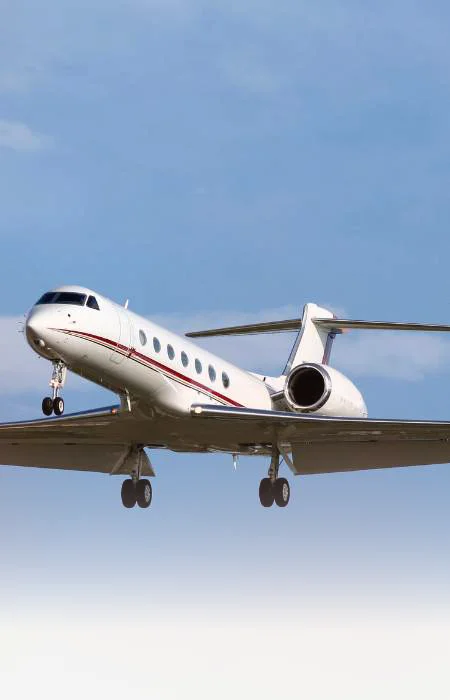
Why choose Arteau Aviation?

12 years of international experience

Carbon offset & sustainable fuel

VIP client support

Strict international standards

Absolute discretion on every flight

Fast and tailored solutions
FAQ
Ciampino (CIA/LIRA) remains the optimal choice for business aviation flights to Rome. Its location 15 km from the historic center, its dedicated private jet infrastructure available 24/7 and its premium FBOs (Signature, Universal) together ensure maximum efficiency.
Transfers to Piazza di Spagna, Via Veneto or EUR take 15 to 25 minutes. Fiumicino (FCO/LIRF) remains the preferred alternative for intercontinental heavy jets and complex night operations, with transfers of 40 to 50 minutes to the center.
The price of a private London-Rome flight (around 2h30 of flight time) varies according to the aircraft category chosen. A Light Jet (Citation CJ3+, 6 passengers) starts at around € 12.500, while a Super Light Jet (Phenom 300, 8 passengers) settles around € 15.200.
For added comfort, a Midsize Jet (Citation XLS+, 8 passengers) stands at around € 18.900. These indicative figures cover handling, navigation and ground services at Ciampino. Our teams then refine the proposal to match your scheduling constraints and your cabin preferences.
Yes, Ciampino operates 24/7 for business aviation, with no time restriction whatsoever. Its fully equipped technical infrastructure (ILS, enhanced lighting, IFR procedures) allows night operations to be conducted in optimal safety conditions.
FBOs maintain their premium services throughout the night, ensuring expedited handling and CIQ clearance at any hour. Such operational flexibility represents a major strategic advantage, whether for urgent business travel or for late returns following an event.


.webp)
.webp)
.webp)
.webp)
.webp)
.webp)

.webp)
.jpg)